
September 15, 2026 5:00 PM – 7:00 PM
Reception and Guest Speaker - Dr. Gillian B. Elliott - 2026 Bayeux Tapestry Replica Exhibit
Admission
Please join us for the Reception and Guest Speaker Talk with Dr. Gillian B. Elliott for the 2026 Bayeux Tapestry Replica Exhibit.
The event starts at 5 pm with a guided tour of the Bayeux Tapestry Replica Exhibit, followed by the reception and Dr. Elliott's presentation at 5:40 pm.
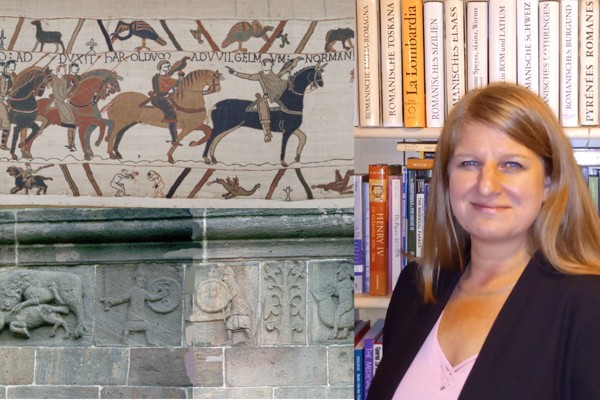
Unfolding Narratives in Space: From the Bayeux Tapestry to the Andlau Abbey Frieze
The Bayeux Tapestry (c. 1077) is often read like a medieval comic strip, the story of the Norman Conquest of 1066 unfolding before the viewer in a chronological sequence of framed scenes. Yet medieval monumental narratives frequently operated differently, inviting viewers to discover layered visual relationships while moving through architectural space. This lecture compares the narrative logic of the Bayeux Tapestry with the Romanesque sculpted frieze of the Abbey of Saints Peter and Paul at Andlau in Alsace (c. 1130–60). Although executed in different media, both monuments organize narrative to articulate ideals of sacred and secular authority. Together they demonstrate how monumental narratives use architectural space to collapse time and geography, encouraging viewers to construct meaning through movement, comparison, and memory rather than through chronology alone.
This event is sponsored by the College of Arts and Letters, University of North Georgia.
Refreshments will be served. The building has ample free parking.
Please RSVP by September 7th.
Dr. Gillian B. Elliott, an independent scholar specializing in medieval art and architecture, with particular interests in Romanesque sculpture, narrative, pilgrimage, and the relationship between images, architecture, and the moving viewer. She received her Ph.D. in Art History from the University of Texas at Austin. Elliott is the author of Sculpted Thresholds and the Liturgy of Transformation in Medieval Lombardy (Routledge, 2022) and co-editor of Art, Architecture, and the Moving Viewer, c. 300–1500 CE: Unfolding Narratives (Brill, 2022). Her research investigates how monumental images shaped medieval ways of seeing through movement, memory, and spatial experience, with current projects focusing on the Bayeux Tapestry, the Hortus Deliciarum, and Romanesque narrative programs in the Holy Roman Empire.